|
Source:
2023 Miyakojima helicopter crash
 06.04.2023/
15:56 LT 06.04.2023/
15:56 LT
Off the coast of Miyakojima in Okinawa,
Japan
A Japan Ground Self-Defense Force UH-60JA
helicopter with 10 personnel aboard went missing in waters off the
southern prefecture of Okinawa on Thursday, with what could be parts of
the chopper later found in the sea.
The helicopter,
which belonged to the 8th Aviation Squadron of the 8th Division,
departed the Miyakojima Sub Base of the Japan Air Self-Defense Force to
conduct terrain reconnaissance of the island, with
Lt. Gen. Sakamoto
and Col. Masaichi Iyoda,
commander of JGSDF Camp Miyakojima, among the 10 personnel on board. The
helicopter vanished from radar at about 18 km (approx. 11 miles)
northwest, just two minutes after making contact with air traffic
control at Shimojishima Airport.
The aircraft involved, registration
JG-3106/43106, was a Mitsubishi UH-60JA, which was based on the Sikorsky
S-70, commonly known as the Blackhawk, was used by all of the branches
of Japan Self-Defense Forces. The involved aircraft, UH-60JA is a
utility version for the Japan Ground Self-Defense Force. This aircraft
was known for its reliability within the force, since it had double
engines that were able to operate even when one was out.
Flight:
All times are in JST, and in 24-hour notation.
At 15:46 on April
6, 2023, the UH-60JA utility helicopter belonging to the 8th Aviation
Squadron of the 8th Division (registration number: 43106A, Hereinafter
referred to as "helicopter".) departed the Miyakojima Sub Base of the
Japan Air Self-Defense Force to conduct terrain reconnaissance of the
island, carrying 2 pilots, 2 mechanics and 6 members for the
reconnaissance mission (including LTG Yuichi Sakamoto, commander of the
8th Division). At that time, the helicopter communicated with the air
traffic control, "We have taken off, will be flying over the coastline."
The air traffic controller instructed to change to a different control
area, saying, "Contact the air traffic controller in Shimojishima on the
next frequency." The helicopter side replied, "Understood." (These are
normal communications)
At about 15:51:30, the security camera
installed facing east at Karimata Elementary School in Miyakojima
captured images of the helicopter flying normally.
At about 15:53:17, the security camera
installed facing north at Ikema Elementary and Junior High School in
Miyakojima captured the helicopter flying normally. As a result of video
analysis of these two school security cameras, it was flying at an
altitude of about 195m (about 640 ft) at about 237 km/h (about 147 mph)
(UH-60JA's normal cruising speed is about 240 km/h, which is normal
flight speed). It seems that the altitude is about 45m higher than the
minimum safe altitude stipulated by the Civil Aeronautics Act. In
addition, former Lt. Gen. Koichi Isobe (was a helicopter pilot), who
confirmed these two videos, said, "It looks like it was flying normally,
not in a way that would interfere with the flight."
 At
about 15:54, the ATC from Shimojishima said, "When you enter the air
traffic control area of Shimojishima Airport, contact the Shimojishima
ATC frequency." This was the last communication exchange, and there was
no communication to report anomalies.[5][9] It was also around this
point that an American tourist, a former sailor of the US Navy, took a
video of the helicopter flying at about 400–450 metres (1,310–1,480
feet) in altitude along the eastern coast of Ikema Island. At this
point, the helicopter was flying straight, the sound was normal and no
abnormalities were observed. At
about 15:54, the ATC from Shimojishima said, "When you enter the air
traffic control area of Shimojishima Airport, contact the Shimojishima
ATC frequency." This was the last communication exchange, and there was
no communication to report anomalies.[5][9] It was also around this
point that an American tourist, a former sailor of the US Navy, took a
video of the helicopter flying at about 400–450 metres (1,310–1,480
feet) in altitude along the eastern coast of Ikema Island. At this
point, the helicopter was flying straight, the sound was normal and no
abnormalities were observed.
At 15:56, the helicopter vanished from the
radar in the oceanic airspace about 18 km northwest of Miyako Airport.
The helicopter flew almost as planned at an altitude of 150 m (490 ft)
until just before it disappeared, and there were no radio communications
to notify emergency situations, no emergency transponder signals that
are transmitted when a crew member evacuates (Squawk 7700) and no
emergency radios were transmitted.
At the time of the accident, the visibility
was over 10 kilometres (6.2 miles), the weather was clear, the south
wind was about 7m, the wave height was about 1m. There was no noticeable
development of cumulonimbus clouds, and no lightning was detected. In
addition, the depth of water in the sea area around the site is 20m at
the shallowest point and 200m at the deepest point. No damage has been
confirmed to vessels to area around the site or in the sea area. The
last known altitude of the helicopter is the lowest limit of the safe
flight altitude stipulated by the Civil Aeronautics Law, which meant
there was no legal problem, and it was the usual flight method for the
JGSDF helicopters.
After late March 2023, the involved
helicopter underwent a special inspection after flying for 50 hours, and
as a result of a safety confirmation flight, it was determined that
there were no problems with the aircraft. Upon examination of the
recovered slider door, it was found that it had been locked, and there
was no sign of any attempt to open it in an emergency. There is a high
possibility that it was an extremely short time from the occurrence of
the anomaly to the crash, and it is possible that the sudden anomaly
occurred in about 2 minutes from the last communication to the
disappearance from the radar and the crash occurred.
By the night of April 13, a total of 22
fragments and parts of the helicopter had been found and recovered, of
which 15 were recovered along the coast and offshore of Irabu Island to
the south of the accident site, and 7 were recovered from the sea area
to the north of the accident site.
Around 8:30 on April 16, a saturation diver
who dived from the submarine rescue ship "Chihaya" found the fuselage of
the accident aircraft and five people (which looked like crew members)
on the seabed at a depth of 106 metres (348 feet) on the north side of
the Irabu Island. As of the night of April 16, two of the five people
found on the seafloor have been confirmed dead.
The Flight Data Recorder (hereinafter
referred to as "FDR") has not been recovered, but this is due to unique
reasons to GSDF. In the case of Maritime and Air Self-Defense Force
helicopters, which often fly over the ocean, the FDR is attached to the
outside of the aircraft, and when it detects a unique impact, it
automatically ejects itself and separates from the aircraft, making it
easy to find in the event of an accident. It has a strobe light emission
and a function to emit a position signal. However, in the case of Ground
Self-Defense Force helicopters, since most of their flights are on land,
if a small FDR separates in the event of an accident, even if there is a
strobe light, it is rather difficult to search in the wilderness or
forest, and it is easy for the enemy to take it away. It is installed
inside the aircraft and does not have a position transmission function
by itself. For these reasons, it is thought that recovery is not
possible unless the entire aircraft is found and recovered.
It was also determined that this helicopter
was not equipped with emergency floats. According to the Civil
Aeronautics Act, the float is required to be installed on "helicopters
that fly over water without islands for 30 minutes or more, or that also
fly 185 kilometres (115 miles) or more." As government helicopters, the
Maritime Self-Defense Force and the Japan Coast Guard equip all
aircraft, and the Ground Self-Defense Force equips aircraft deployed in
the Okinawa area, but the aircraft of the 8th Division (Kyushu area) is
within the normal operation range. It was not equipped because there
were no isolated islands that exceeded the provisions stipulated by the
Civil Aviation Law. In addition, this flight is also flying via the
island in a stepping stone style, which meant there was no legal
problem.
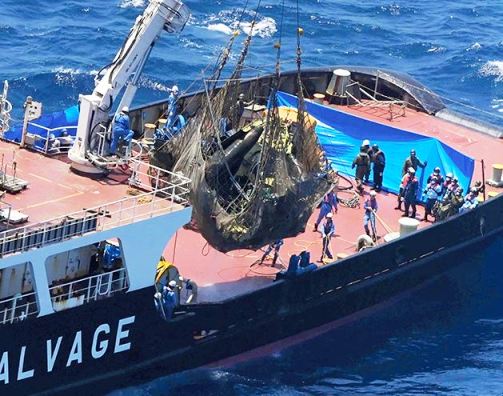
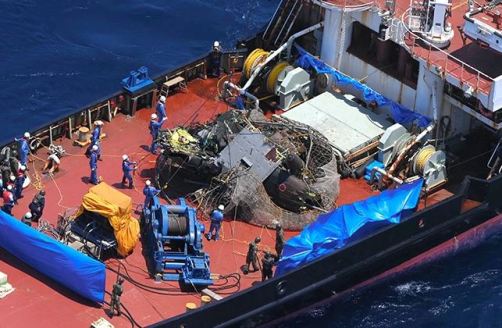
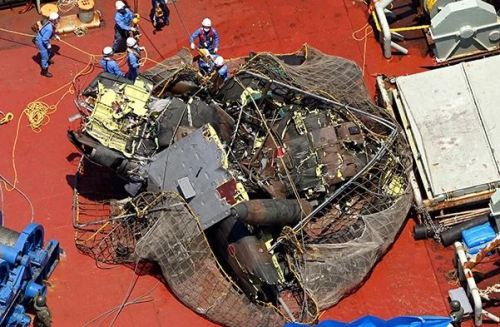
Part of the helicopter was recovered on May
2, 2023, along with 6 out of the 10 deceased crew members.
 Investigation: Investigation:
The Ground Self-Defense Force established an accident investigation
committee and decided to ground the aircraft except for disaster relief
missions such as transporting emergency patients. In addition, the
helicopter of the same system operated by the Maritime Self-Defense
Force and the Air Self-Defense Force have different specifications from
this model, so it was determined that there were no problem to continue
to operate.
The cause of this accident is officially published by the JGSDF on March
14, 2024. The investigation determined that the No. 2 Engine and No. 1
Engine lost power in sequence, and while the failure of No. 2 Engine is
attributed to an undocumented, assumed temporary issue called "rollback"
either in the engine control system or relevant pneumatic lines, the
reason for the failure of No. 1 Engine could not be ascertained. The
committee made several safety recommendations regarding inspections of
engines, documentation of abnormal behaviours and crew training.
|


