|
 10.05.2023/
07:49 LT 10.05.2023/
07:49 LT
San Clemente Island, California - USA
Aviation
Investigation Final Report
A Phoenix Air Group
GATES LEAR JET 36A, N56PA,
with callsign FENIX01, was destroyed when it crashed into the sea about
a mile southwest off San Clemente Island, California. The three
occupants were killed.
The airplane departed Point Mugu Naval Air
Station (NTD) at 07:23 as the lead airplane in formation with a second
Learjet airplane utilizing the call signs FENIX01 (N56PA) and FENIX02
(N544PA). The flight proceeded south towards San Clemente Island with
the FENIX02 flying in close formation with FENIX01. The purpose of the
flight was to participate in training exercises with the United States
Navy in Warning Area 291 (W291). There were three civilian crewmembers
onboard each airplane.
 Shortly after entering the training area at
15,000 ft mean sea level (msl) the wingman positioned on the right side
of the accident airplane, observed the flaps on the accident airplane
were partially extended. They notified the pilot of the accident
airplane who acknowledged the radio call. The wingman then observed the
flaps retract and observed white or gray colored “smoke or gas” coming
from the left aft side of the airplane. The pilot in the accident
airplane then radioed that they detected an odor in the cabin. Seconds
later, the wingman observed red fluid on the underside of the tail cone
followed by flames coming from around the aft equipment bay (tail cone)
access door. They informed the accident pilots that their airplane was
on fire and the accident pilot declared an emergency along with their
intentions to land at a nearby airfield on the island. The wingman took
over leading the formation and maneuvered in front of the accident
airplane. The wingman last observed and heard radio transmissions from
the accident airplane a short time later as they descended through about
7000 ft msl. The flight was above an overcast cloud layer that
obstructed the view of the island at that time. Recorded ADS-B data
showed that the accident airplane subsequently made a series of
descending turns before the data ended. Shortly after entering the training area at
15,000 ft mean sea level (msl) the wingman positioned on the right side
of the accident airplane, observed the flaps on the accident airplane
were partially extended. They notified the pilot of the accident
airplane who acknowledged the radio call. The wingman then observed the
flaps retract and observed white or gray colored “smoke or gas” coming
from the left aft side of the airplane. The pilot in the accident
airplane then radioed that they detected an odor in the cabin. Seconds
later, the wingman observed red fluid on the underside of the tail cone
followed by flames coming from around the aft equipment bay (tail cone)
access door. They informed the accident pilots that their airplane was
on fire and the accident pilot declared an emergency along with their
intentions to land at a nearby airfield on the island. The wingman took
over leading the formation and maneuvered in front of the accident
airplane. The wingman last observed and heard radio transmissions from
the accident airplane a short time later as they descended through about
7000 ft msl. The flight was above an overcast cloud layer that
obstructed the view of the island at that time. Recorded ADS-B data
showed that the accident airplane subsequently made a series of
descending turns before the data ended.
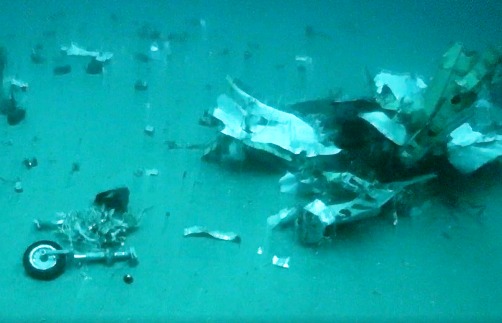
 The airplane wreckage was
located underwater about 4 miles northwest of the last ADS-B data point.
The wreckage was highly fragmented, and the debris field extended
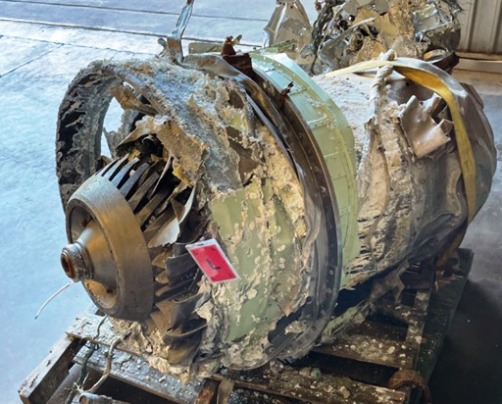
several hundred feet along the ocean floor. Salvage operations were able
to recover about 40 percent of the airplane wreckage. The airplane wreckage was
located underwater about 4 miles northwest of the last ADS-B data point.
The wreckage was highly fragmented, and the debris field extended
several hundred feet along the ocean floor. Salvage operations were able
to recover about 40 percent of the airplane wreckage.
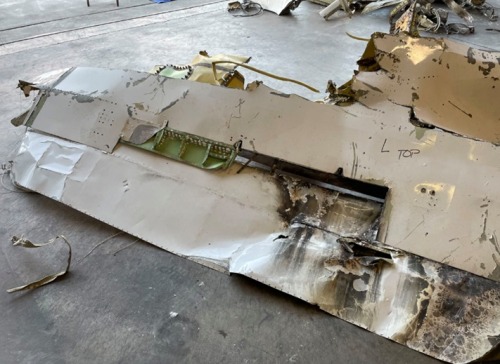
Observed fire and heat damage patterns indicate the fire likely started
in proximity to the where the pressurized fuel motive flow line
connected to the firewall fitting where the missing b-nut was located. A
leak from the pressurized motive flow line would have sustained and
allowed an uncontrollable fire to develop. The sustained fire likely
affected controllability of the airplane and resulted in the pilots’
loss of control of the airplane.
Probable Cause and Findings
The National Transportation Safety Board determines the probable
cause(s) of this accident to be: The pilots’ loss of airplane control
following a catastrophic fire that started on the left side of the aft
equipment bay (tail cone). The fire likely initiated from a leak from
the left fuel motive flow line due to a b-nut that loosened for reasons
that could not be determined based on available evidence.
|


