|
 22
February 2023/ 11:56 LT 22
February 2023/ 11:56 LT
1,5 km S of Little Rock-Bill and Hillary Clinton National Airport, AR
(LIT) - United States of America
Aviation
Investigation Final Report
On February 22, 2023, about 1156 central
standard time (CST), a Beech B200 airplane, N55PC, was
destroyed when it was involved in an accident near Little Rock,
Arkansas. The commercial pilot and four passengers sustained fatal
injuries.
The flight intended to transport Consulting Toxicology and Environmental
Health (CTEH) emergency workers from Little Rock, Arkansas, to Columbus,
Ohio, in response to an alloy plant explosion in Bedford, Ohio. The
airplane was owned and operated by CTEH.
The pilot and four passengers were departing in the multi-engine
turbopropeller-powered airplane when the accident occurred. Surveillance
video indicated that the takeoff and initial climb appeared normal,
however, the airplane than began to lose airspeed and altitude until the
airplane entered a left roll and descended toward the ground. Just after
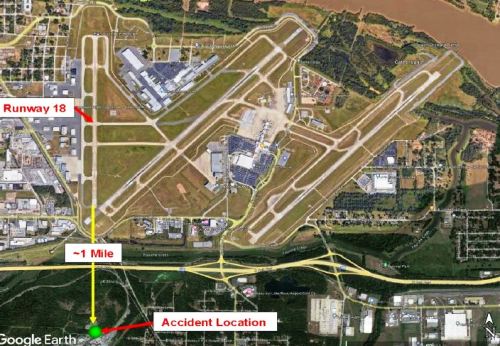
the airplane went out of sight, the camera recorded a rising plume of
smoke about 1 mile from of the departure end of the runway. Shortly
after the plume of smoke appeared, the camera appeared to shake from
wind, and recorded blowing debris and heavy rain on the ramp where the
camera was located. Just before and during takeoff, the camera showed
that the ramp was dry with no rain or noticeable wind. No radio or
distress calls were heard from the pilot. Several witnesses saw the
airplane’s takeoff and initial climb and they described the airplane as
struggling to climb and reported that it entered a steep bank and
descent toward the ground shortly after takeoff. The witnesses
characterized the weather conditions as stormy and windy, with a weather
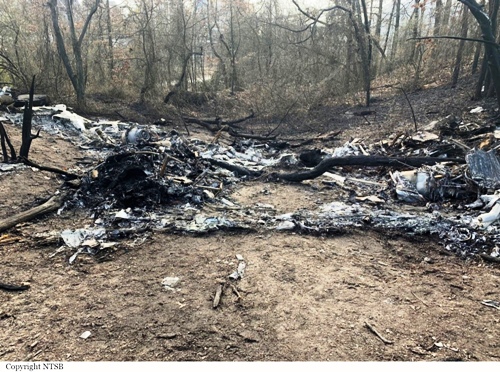
front passing through the area. The wreckage of the airplane was found
amidst heavily wooded terrain adjacent to a factory about 1 mile south
of the departure end of runway 18 and a post-impact fire consumed most
of the airplane. Detailed examinations of the airframe, engines, flight
controls, and propellers did not reveal any pre-impact mechanical
anomalies that would have precluded normal operations. Both engines and
propellers exhibited evidence of rotation at the time of impact, and
several large diameter tree branches at the accident site were found cut
consistent with propeller blade strikes, also indicating that the
engines were producing power at the time of impact.
A performance study indicated that the airplane
climbed to a maximum altitude of about 386 ft above ground level before
it began to descend. Review of airplane performance from previous
takeoffs from the same runway indicated that the airplane’s climb
performance during the accident initial climb takeoff was diminished.
The reason for the diminished performance could not be determined.
Review of weather information indicated that the airplane departed about
the time a line of extreme intensity precipitation was approaching, and
weather reporting equipment at the airport indicated a wind shift
associated with this oncoming line of precipitation. A wind shear alert
was active in the control tower advising of 15 to 20 kt gains about 1
mile from the runway.
 Based on the observation weather data, it is
likely that, during the initial climb, the airplane encountered wind
with magnitudes between 20 and 30 kts that likely varied in direction
about 50°, from a quartering headwind to a crosswind condition. In the
minutes following the accident time, this wind continued to shift to a
quartering tailwind condition for the departure runway and increased in
magnitude to 30 to 40 kts. There was no evidence to suggest that the
airplane encountered a microburst or downdraft. Based on available
information, the performance study could not conclude why the airplane
had diminished performance during the initial climb after takeoff.
Although there was diminished performance during the initial climb, it
could not be attributed to a airframe, engine, or system anomaly.
Although the weather was deteriorating at the time of the accident, and
there were wind shifts in the area, a weather study determined that the
wind shifts likely contributed to, but did not cause the accident. The
pilot’s autopsy was limited by injury but identified severe coronary
artery disease. Within the limits of the autopsy, there was no evidence
that a medical event contributed to the accident. The pilot’s toxicology
testing detected a low level of ethanol in cavity blood only; however,
the small amount of ethanol may have been produced postmortem. It is
unlikely that the effects of ethanol contributed to the accident. Based on the observation weather data, it is
likely that, during the initial climb, the airplane encountered wind
with magnitudes between 20 and 30 kts that likely varied in direction
about 50°, from a quartering headwind to a crosswind condition. In the
minutes following the accident time, this wind continued to shift to a
quartering tailwind condition for the departure runway and increased in
magnitude to 30 to 40 kts. There was no evidence to suggest that the
airplane encountered a microburst or downdraft. Based on available
information, the performance study could not conclude why the airplane
had diminished performance during the initial climb after takeoff.
Although there was diminished performance during the initial climb, it
could not be attributed to a airframe, engine, or system anomaly.
Although the weather was deteriorating at the time of the accident, and
there were wind shifts in the area, a weather study determined that the
wind shifts likely contributed to, but did not cause the accident. The
pilot’s autopsy was limited by injury but identified severe coronary
artery disease. Within the limits of the autopsy, there was no evidence
that a medical event contributed to the accident. The pilot’s toxicology
testing detected a low level of ethanol in cavity blood only; however,
the small amount of ethanol may have been produced postmortem. It is
unlikely that the effects of ethanol contributed to the accident.
Probable Cause
The National Transportation Safety Board
determines the probable cause(s) of this accident to be:
The loss of control during initial climb for
undetermined reasons.
Contributing to the accident were the sudden wind
shifts during the initial climb.
|


