 |
Links Media Travel Airports Maps Weather Slides Archive
Five killed, including patient, when medical plane crashes in Nevada |
|
||
|
Aviation Investigation Final Report
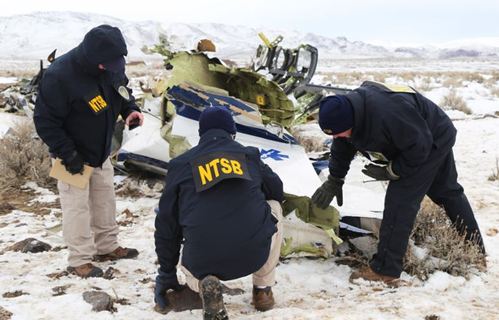
On February 24, 2023, about 2114 Pacific standard time, a Pilatus PC-12/45, N273SM, was substantially damaged when it was involved in an accident near Stagecoach, Nevada. The pilot, flight paramedic, flight nurse, and two passengers were fatally injured. The pilot, two
medical crew members, and two passengers departed on the medical
transport flight, which was operating on an instrument flight rules
(IFR) flight plan in night instrument meteorological conditions (IMC).
Onboard data and ADS-B flight track information showed that, between 1
and 3 minutes after takeoff, the autopilot disengaged and then
reengaged; however, the airplane continued to fly a course consistent
with the published departure procedure. About 11 minutes after takeoff,
the airplane turned about 90° right, away from the next waypoint along
the departure procedure, and remained on that heading for about 47
seconds. Around this time, the airplane’s autopilot was disengaged again
and was not reengaged for the remainder of the flight. Also, about this
time, the airplane’s previously consistent climb rate stopped, and the
airplane maintained an altitude of about 18,300 ft mean sea level (msl)
for about 20 seconds, even though the pilot had been cleared to climb to
25,000 ft msl. The airplane subsequently turned left to a northeasterly
heading and climbed to about 19,400 ft msl before entering a descending
right turn. Shortly after entering the right turn, the airplane’s rate
of descent increased from about 1,800 ft per minute (fpm) to about
13,000 fpm, and the rate of turn increased before ADS-B tracking
information was lost at an altitude of about 11,100 ft msl, in the
vicinity of the accident site. Recorded weather
conditions at the departure airport about the time of departure included
1 ¾ statute miles visibility and a cloud ceiling 1,700 ft above ground
level (agl). The departure airport and surrounding areas had been
impacted by significant winter weather throughout the day of the
accident, and the pilot who was on call for the accident operator
earlier that day turned down a flight request due to the weather
conditions. Another air medical operator, who operated the same make and
model airplane as the accident airplane, also turned down a request for
a flight in the area due to the low visibility, turbulence, and icing
conditions. The airplane was equipped with several sources of recorded data, including a central advisory and warning system (CAWS) computer. The CAWS computer, which captured autopilot status, among other parameters, was significantly impact damaged and missing one of the memory chips that stored time information; therefore, the two autopilot disengagements could only be identified as occurring in two-minute windows after elapsed takeoff time, with the first about 1 to 3 minutes after takeoff, and the second between about 2 and 4 minutes before the accident. There are several ways in which the autopilot could have been automatically or manually disengaged during the accident flight; however, based on the available CAWS data and examination of the airplane and system components, the reason for the two autopilot disengagements during the accident flight could not be determined. Following the second autopilot disengagement, the pilot would have been required to manually maintain control of the airplane while operating in IMC, which increased his susceptibility to spatial disorientation. The airplane’s subsequent flight path was consistent with a phenomenon known as a “graveyard spiral,” a sensory illusion in which a pilot believes they are flying in a wings-level descent; however, the airplane is actually in a descending turn. Attempts to arrest the descent by pulling back on the control yoke have the effect of tightening the turn and losing altitude at an increasing rate until the airplane’s structural limits are exceeded, resulting in an in-flight breakup, or until the airplane impacts the ground. Graveyard spirals are most common at night or in poor weather conditions where no horizon exists to provide a visual reference to correct misleading inner-ear cues. Autopsy of the pilot revealed a 3 cm fibroblastic meningioma (tumor) in the right parietal section of the brain. The parietal lobe is one of the four major components of the cerebral cortex and has a primary role in the integration of sensory information, including spatial and navigational information. The parietal lobe is also primarily responsible for the integration of visual and vestibular information. The presence and location of the tumor may have impacted the pilot’s ability to synthesize and respond to sensory interpretation from the conditions under which he was flying; however, it is also possible that the tumor may have been an incidental finding without any significant symptoms, and the pilot’s next of kin indicated no changes in his behavior or health before the accident. Based on the available information, whether the effects of the pilot’s undiagnosed brain tumor contributed to the accident could not be determined. The accident pilot was not permanently assigned to the base from which the accident flight departed; rather, he was classified as a “float” pilot, who rotated across the operator’s bases throughout the country. The operator did not have any formal training or mentoring procedures in place to ensure that local area knowledge was passed along to pilots new to a specific operating area; the investigation was unable to establish the pilot’s experience operating in night IMC over mountainous terrain. All three crewmembers of the accident flight were relatively new in their respective roles. The pilot was hired by the operator about five months before the accident, while both clinicians had been assigned to the airplane for about six months. The company’s website highlighted the “Three to say go, one to say no” protocol as a best practice among air ambulance providers that empowers any member of the flight team, for any reason, to raise a safety concern. For rotorcraft flights, the operator required that clinicians with less than one year of experience be paired with clinicians with more than one year of experience, a practice that leveraged the flight team’s collective experience to benefit flight safety. However, fixed-wing operations were not subject to this requirement.
The operator also
required that a flight risk assessment be completed before each flight;
however, no such assessment was located for the accident flight. Even if
a risk assessment had been conducted, the crew’s relative inexperience,
and lack of information about the earlier turndowns, increased the
likelihood of a knowledge-based error during the risk assessment and
decision-making process. That an inexperienced flight crew was permitted
to accept the accident flight given the weather conditions and the
previous flight turndowns with no additional approval demonstrated an
insufficient risk assessment process and lack of organizational
oversight. Another fatal accident involving the accident operator
occurred 71 days before this accident; the investigation into that
accident also revealed the lack of a preflight risk assessment.
Probable Cause The National Transportation Safety Board determines the probable cause(s) of this accident to be: The pilot’s loss of control due to spatial disorientation while operating in night instrument meteorological conditions, which resulted in an in-flight breakup. Contributing to the accident was the disengagement of the autopilot for undetermined reasons, as well as the operator’s insufficient flight risk assessment process and lack of organizational oversight. |
||||
|
Връзки
Медии
Пътуване
Летища
Карти
Време
Слайдове
Архив |
   |
|||
|
24.02.2023 - AircrashConsult |
||||
 24
February 2023/ 21:14 LT
24
February 2023/ 21:14 LT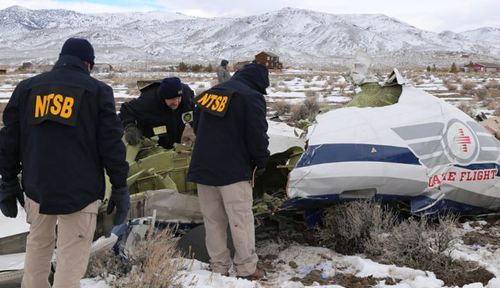 The operator’s procedures also required company
dispatchers to inform flight crews if a flight had been turned down by
another operator. Although the weather can change throughout the course
of a given day, the fact that other pilots and operators turned down
flights due to weather in the area on the day of the accident should
have been relayed to both the pilot and medical crew as part of their
decision-making process. However, review of communication logs did not
indicate that the company’s dispatchers made the accident crew aware of
the turndowns earlier on the day of the accident.
The operator’s procedures also required company
dispatchers to inform flight crews if a flight had been turned down by
another operator. Although the weather can change throughout the course
of a given day, the fact that other pilots and operators turned down
flights due to weather in the area on the day of the accident should
have been relayed to both the pilot and medical crew as part of their
decision-making process. However, review of communication logs did not
indicate that the company’s dispatchers made the accident crew aware of
the turndowns earlier on the day of the accident.